
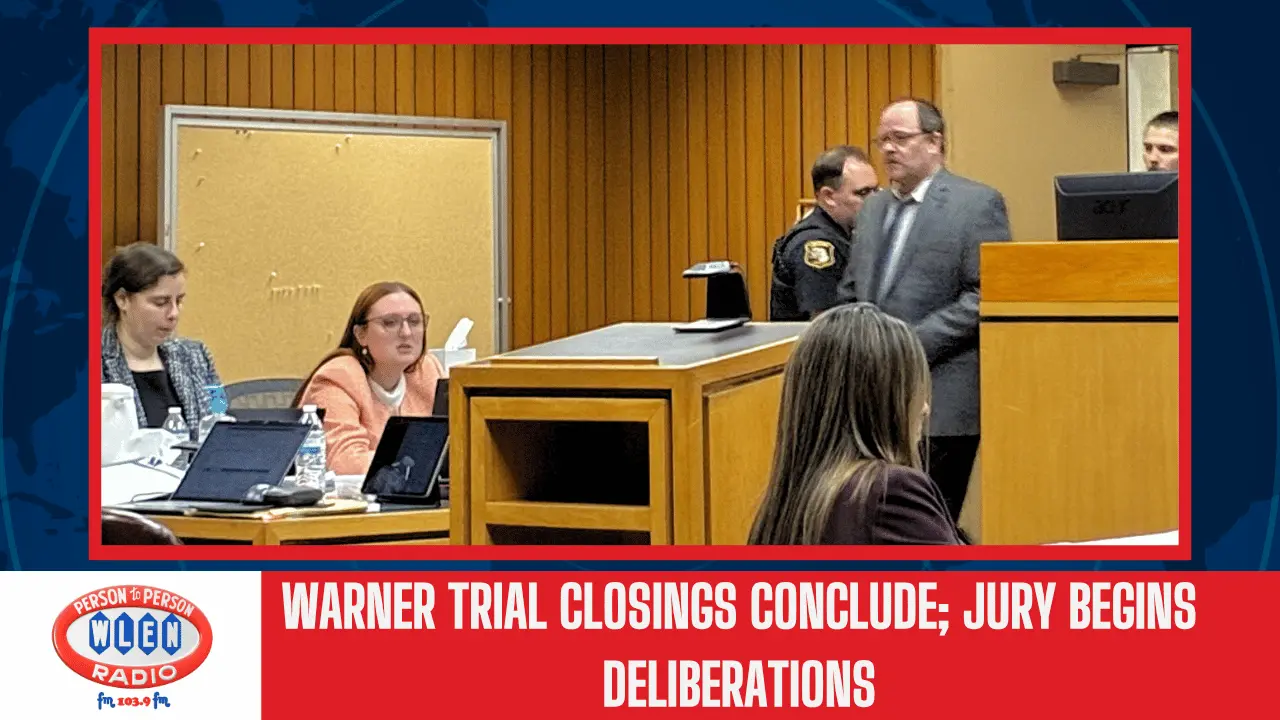
ADRIAN — Closing arguments began Thursday morning in the Warner trial in Lenawee County Circuit Court as prosecutors outlined their final narrative against Dale Warner in connection with the 2021 death of his wife. Jurors heard the state’s summary of evidence before the defense begins its closing later in the proceedings.
Morning Session
Before closing arguments began, the court addressed several procedural matters related to jury instructions and evidentiary records. Defense attorneys asked the court to allow jurors to consider voluntary manslaughter as a lesser charge in the case.
Defense attorneys argued that testimony suggested a confrontation may have occurred after the victim planned to tell Warner she intended to pursue a divorce and sell their trucking business. They contended that such a discussion could potentially constitute provocation under Michigan law.
Lenawee County Circuit Court Judge Michael Olsaver denied the request. The judge ruled the evidence presented during the Warner trial did not support a heat-of-passion scenario that would justify a voluntary manslaughter instruction. Jurors will instead consider first-degree or second-degree murder under the open murder charge.
Prosecutors then began their closing argument by summarizing the relationship between the couple and the evidence presented over the course of the trial.
The state told jurors the Warner trial evidence shows a pattern of monitoring and surveillance by the defendant in the years leading up to the disappearance. Prosecutors pointed to testimony that Warner accessed vehicle location information thousands of times between 2019 and 2021.
Witness testimony also described a GPS tracking device placed on the victim’s vehicle and alleged attempts to obtain access to her personal communications. Prosecutors also referenced messages introduced during the Warner trial that described disputes between the couple and complaints about being monitored.
The state also referenced witness testimony describing visible bruising on the victim observed in the weeks before she disappeared.
Prosecutors told jurors that witnesses testified the victim had become increasingly frustrated with the relationship and had recently expressed intentions to leave the marriage and sell the family business.
During the morning proceedings, the court also confirmed the admission of numerous exhibits presented during the Warner trial, including photographs and investigative records.
The prosecution’s closing argument continued through the morning as attorneys summarized their theory of the case for jurors.
Afternoon Session
Closing arguments concluded Thursday afternoon in the Warner trial in Lenawee County Circuit Court, with the judge delivering final legal instructions before the case was handed to jurors for deliberation.
The afternoon session followed a morning of prosecution closing arguments in the Warner trial, where attorneys summarized their interpretation of evidence presented during several weeks of testimony. The court then moved into the final phase of the trial process.
Lenawee County Circuit Court Judge Michael Olsaver instructed jurors on the legal standards they must apply while reviewing the evidence. The judge reminded jurors that the defendant is presumed innocent and that prosecutors must prove every element of the charged crimes beyond a reasonable doubt. Jurors were also told that attorney statements and arguments are not evidence and that their decision must rely only on testimony and exhibits admitted during the trial.
Judge Olsaver also explained how jurors should evaluate witness testimony, including weighing credibility, expert opinions and circumstantial evidence when determining the facts of the case.
The court outlined the charges jurors must consider in the Warner trial, including open murder and tampering with evidence.
Under Michigan law, the open murder charge allows jurors to consider both first-degree premeditated murder and the lesser offense of second-degree murder. Judge Olsaver explained that a conviction for first-degree murder would require jurors to find beyond a reasonable doubt that the killing was intentional, deliberate and premeditated.
Jurors were told they may evaluate intent and planning based on the defendant’s actions, statements and surrounding circumstances presented during the Warner trial.
The judge also explained the elements of the tampering with evidence charge. Prosecutors must prove that the defendant intentionally altered, concealed, destroyed or otherwise interfered with evidence connected to a criminal investigation or official proceeding.
Jurors were reminded that the defendant has an absolute right not to testify and that the decision not to take the stand cannot be considered when reaching a verdict.
After final instructions were completed, the court dismissed several alternate jurors before the remaining panel began deliberations. A verdict must be unanimous under Michigan law.
Jurors then retired to the deliberation room to begin reviewing the evidence and testimony presented during the Warner trial. The jury’s decision will determine whether the defendant is convicted or acquitted on the charges brought in connection with the 2021 death.