Trial reveals key K-9 search limits
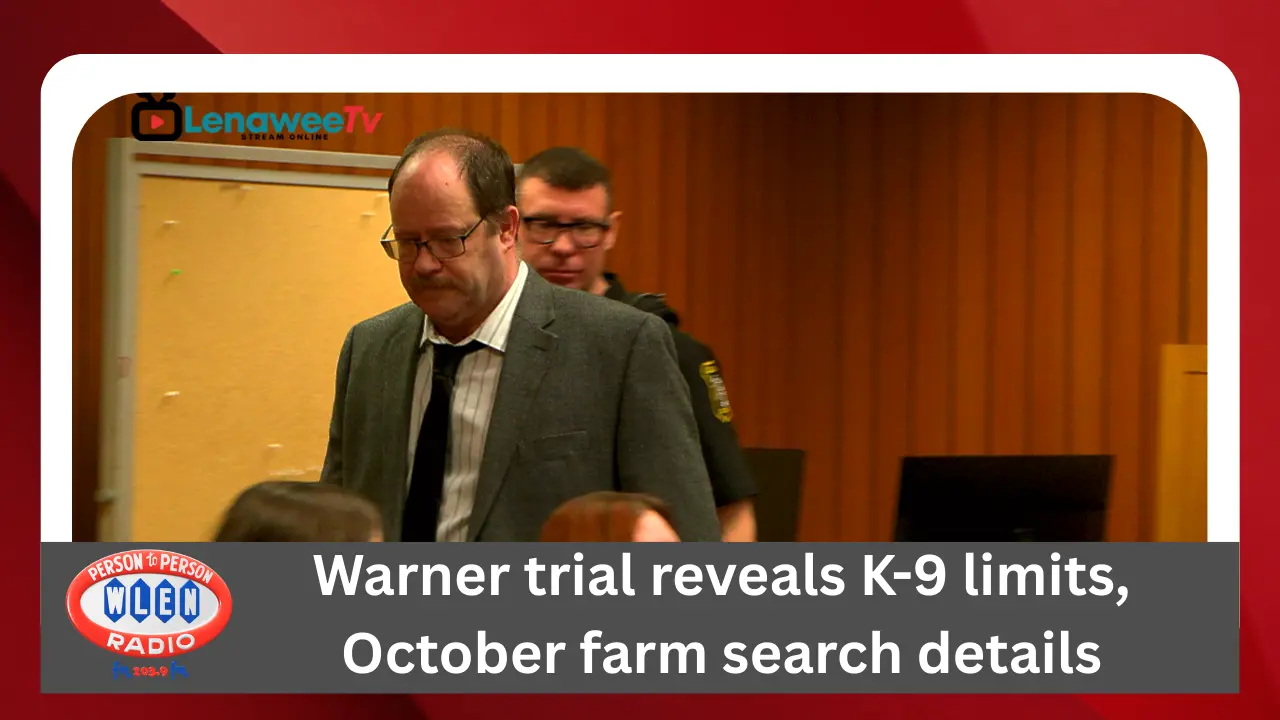
ADRIAN — The Warner trial resumed Thursday morning with forensic exhibits admitted and testimony from a Michigan State Police K-9 handler detailing early searches of the Munger Road property. The Warner trial testimony focused on what cadaver and tracking dogs can detect, and what they cannot.
The 39th Circuit Court jury heard from Michigan State Police Trooper Jack Taft, who has approximately 25 years of service and worked as a K-9 handler for more than eight years. Taft testified he was called to the Munger Road property April 27, 2021, at the request of law enforcement investigating a missing person case.
Taft initially responded with a dual-purpose narcotics and tracking dog and later requested a cadaver dog trained to detect human blood, bone and tissue. He said cadaver dogs are specifically trained to identify trace human remains and can differentiate between human and animal remains.
Taft testified he began searching portions of the property, including a dry fertilizer barn, before consent to search was revoked on April 27. He later returned after dark when a cadaver dog was present. Taft told the jury he did not enter the spray barn with a dog during those searches.
During direct examination, prosecutors asked whether a cadaver dog could detect human remains sealed inside a welded anhydrous tank. Taft testified that unless blood, bone or tissue were present outside the container, the dog would likely not detect remains sealed inside.
On cross-examination, defense attorney Mary Chartier questioned Taft extensively about the limits of canine scent detection. Taft testified that cadaver dogs require actual human remains to alert and do not respond to odor alone if no blood, bone or tissue is present.
Earlier in the morning, the court admitted multiple laboratory reports, including paint and fingerprint analysis exhibits, over defense objection.
Testimony shifted through the morning from canine search testimony to digital evidence, as jurors heard from a law enforcement witness who analyzed cell phone data connected to the investigation. The focus moved from what search dogs could detect at the property to how phone records and location data fit into the broader investigative timeline prosecutors are presenting to the jury.
Jurors heard testimony from a law enforcement witness specializing in digital and cell phone analysis. The witness outlined how call detail records and cellular location data were obtained and reviewed as part of the investigation. Prosecutors used the testimony to walk jurors through the general process of mapping phone activity, including timestamps, tower connections and sector data.
The witness explained that cell phone records can help establish patterns of communication and approximate device movement based on tower usage, but do not provide exact GPS pinpoint accuracy unless specific location services are engaged. The testimony focused on building a timeline using digital records rather than physical evidence, adding a technological layer to the prosecution’s case.
FBI search warrant details October property sweep
Testimony then turned to an earlier search conducted months after the initial K-9 deployment.
Jurors heard from FBI Special Agent Henrik Impola, who testified he was part of an evidence response team that executed a search warrant at 2170 Munger Road in October 2021. Impola said his team was responsible for searching vehicles, equipment and outbuildings on the farm, including Building 7, commonly referred to as the spray barn.
Impola testified his team logged and searched 37 vehicles, including farm equipment and trailers, and manually inspected tanks and containers that were accessible and not pressurized. He told jurors he did not open pressurized or chemical-filled tanks, explaining he lacked both the equipment and a specific reason at the time to access them.
During the vehicle searches, Impola said team members located journals, planners and loose handwritten notes inside a black Chevrolet associated with Dale Warner. The materials were photographed in place but not seized. Impola testified he consulted a supervisor regarding whether to collect the items and was directed to document them but leave them on scene.
Prosecutors displayed excerpts of the handwritten entries for the jury, which included dated notes spanning 2019 through May 2021. Several entries referenced tracking locations, arguments, suspicions and the days immediately following Dee Warner’s disappearance, including entries noting sheriff visits and property searches.
On cross-examination, defense attorney Mary Chartier emphasized that the materials were not taken into evidence at the time and that Impola conducted only a preliminary review on scene, directing photographs of handwritten pages rather than reading every entry in full. Impola acknowledged he did not interview Dale Warner and that his role was limited strictly to the execution of the October search warrant.
Testimony concluded with Michigan State Police Detective Sgt. Scott Singleton, who testified he joined the investigation in March 2022 as part of a multi-agency task force that later included the Lenawee County Sheriff’s Office and the FBI.
Singleton told jurors he reviewed hundreds of hours of surveillance footage from the Munger Road farm, including motion-activated cameras in multiple buildings. He testified that no interior cameras were located inside Building 7, the spray barn.
Singleton said the camera timestamps were approximately 1 minute and 35 seconds off and were calibrated by comparing them to body camera footage from responding officers.
He testified that after Dee Warner’s body was located in August 2024, investigators revisited earlier footage and body camera video to identify a tank visible on the property April 27, 2021. Singleton said that discovery prompted additional review of welding equipment, angle grinders and chains observed on April 25, 2021 surveillance footage.
Singleton also testified that investigators executed a subsequent search warrant at the farm days after Warner’s body was found, collecting paint samples from multiple containers for laboratory comparison to the tank.
Under cross-examination, Singleton acknowledged he did not personally participate in every property search tied to tank locations and confirmed that certain investigative theories developed over time as additional evidence was discovered
Court adjourned following Singleton’s testimony and is scheduled to resume Friday morning.